Nicholas Carr Does It Matter Pdf To Word
Contents.Career Nicholas Carr originally came to prominence with the 2003 article 'IT Doesn't Matter' and the 2004 book Does IT Matter? Information Technology and the Corrosion of Competitive Advantage. In these widely discussed works, he argued that the strategic importance of in business has diminished as has become more commonplace, standardized and cheaper. His ideas roiled the information technology industry, spurring heated outcries from executives of, and other leading technology companies, although the ideas got mixed responses from other commentators. In 2005, Carr published the controversial article 'The End of Corporate Computing' in the, in which he argued that in the future companies will purchase information technology as a utility service from outside suppliers.Carr's second book, The Big Switch: Rewiring the World, From Edison to Google, was published in January 2008. It examines the economic and social consequences of the rise of Internet-based ' comparing the consequences to those that occurred with the rise of in the early 20th century.In the summer of 2008, published Carr's article ' as the cover story of its annual Ideas issue.
Highly critical of the Internet's effect on cognition, the article has been read and debated widely in both the media and the. Carr's main argument is that the Internet may have detrimental effects on cognition that diminish the capacity for concentration and contemplation.Carr's 2010 book, develops this argument further.
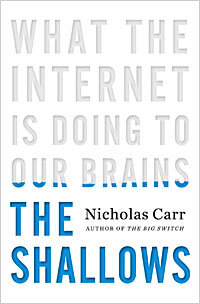
Discussing various examples ranging from 's typewriter to drivers', Carr shows how newly introduced technologies change the way people think, act and live. The book focuses on the detrimental influence of the Internet—although it does recognize its beneficial aspects—by investigating how has contributed to the fragmentation of knowledge. When users search the Web, for instance, the context of information can be easily ignored. 'We don't see the trees,' Carr writes. 'We see twigs and leaves.' One of Carr's major points is that the change caused by the Internet involves the physical restructuring of the human brain, which he explains using the neuroscientific notion of '.'
In addition to being a Pulitzer Prize nominee, the book appeared on the nonfiction bestseller list and has been translated into 17 languages in addition to English.In January 2008 Carr became a member of the Editorial Board of Advisors of. Earlier in his career, Carr served as executive editor of the. He was educated at and.In 2014, Carr published his fourth book, ', which presents a critical examination of the role of computer in contemporary life. Spanning historical, technical, economic, and philosophical viewpoints, the book has been widely acclaimed by reviewers, with the terming it 'essential.'
In 2016, Carr published ', a collection of blog posts, essays, and reviews from 2005 to 2016. The book provides a critique of modern American techno-utopianism, which magazine said 'punches a hole in Silicon Valley cultural hubris.'
Blog Through his blog 'Rough Type,' Carr has been a critic of and in particular the populist claims made for online. In his 2005 blog essay titled 'The Amorality of Web 2.0,' he criticized the quality of volunteer information projects such as and the and argued that they may have a net negative effect on society by displacing more expensive professional alternatives. In a response to Carr's criticism, Wikipedia co-founder admitted that the Wikipedia articles quoted by Carr 'are, quite frankly, a horrific embarrassment' and solicited recommendations for improving Wikipedia's quality.
In May 2007, Carr argued that the dominance of Wikipedia pages in many search results represents a dangerous consolidation of Internet traffic and authority, which may be leading to the creation of what he called 'information plantations'. Carr coined the term 'wikicrats' (a pejorative description of ) in August 2007, as part of a more general critique of what he sees as Wikipedia's tendency to develop ever more elaborate and complex systems of rules and bureaucratic rank or caste over time. Nicholas Carr speaking at the 12th Annual Gilder/Forbes Telecosm Conference at Resort in on May 28, 2008.He holds a B.A. From DartmouthCollege and an M.A., in English and American literature and language, from Books. Digital Enterprise: How to Reshape Your Business for a Connected World (2001).
Does IT Matter? (2004). The Big Switch: Rewiring the World, from Edison to Google (2008, W. Norton). (2010, W.
Norton). The Glass Cage: Automation and Us (2014, W. Norton).
Utopia Is Creepy: and Other Provocations (2016, W. Norton)See also.Notes. December 8, 2003.
June 1, 2003, at the 2004. August 25, 2003. June 2003.
Carr, Nicholas G. (April 15, 2005). Retrieved December 26, 2013. November 19, 2007, at the December 2007. Carr, Nicholas (July 2008).
Retrieved October 6, 2008. November 18, 2013, at Jared Nielsen. Lehrer, Jonah New York Times, June 3, 2010.
Schuessler, Jennifer. The New York Times.
January 28, 2014. March 3, 2008, at the – Britannica Blog, January 25, 2008. December 6, 2010, at the. The New York Times. November 9, 2014. February 1, 2016. Foroohar, Rana.
October 2005. October 6, 2005. May 17, 2007. August 23, 2007.External links Wikiquote has quotations related to:Wikimedia Commons has media related to. on. Carr, Nicholas (July 2008).
Retrieved July 9, 2008. (PDF). Archived from (PDF) on April 21, 2006. Retrieved July 26, 2006. May 1, 2004. August 21, 2004.
January 23, 2008 ITworld.
Our recent interview with Nicholas G. Carr about his article in the May issue of Harvard Business Review caused an uproar in IT circles. His thesis, that IT has become a commodity that no longer provides strategic advantage, was so passionately refuted by readers and some of the big thinkers in the IT world that we felt compelled to give equal time to their views. Kathleen Melymuka spoke separately with Rob Austin and Andrew McAfee, both assistant professors of technology and operations management at Harvard Business School; Paul A.

Strassmann, an IT management consultant, a Computerworld columnist and recently the acting CIO at NASA; and Tom DeMarco, a Cutter Consortium analyst and co-author of (Dorset House, 2003). They make the case for why IT matters more than ever.McAfee: I don't agree that IT doesn't matter, but I think Nick wrote a really interesting article. He provided a great service by focusing the debate.DeMarco: It created a buzz, but it's not a healthy buzz.
All the response doesn't imply a useful argument. It's traceable to the deep-seated ignorance of the article. Carr says that information technology has become so pervasive that, like railroads and electricity, it has lost its strategic value. What's wrong with his argument?DeMarco: The argument is not very well made. He presents three graphs: railroads, electric power and IT.
Each has a very similar curve, so he deduces that information technology is commoditized. But what's really plotted in the graph is the number of computers, which is not the same as information technology.
Boxes have been commoditized for a long time. This is very old news. But he tries to use this to prove IT as a whole is commoditized, and that's just wrong.See a collection of opinion columns on the controversy plus the original interview with Carr at.Austin: He says ubiquity, not scarcity, is the problem with IT. He seems to think that IT is primarily hardware.
The problem is not a scarcity of equipment; it's always been a scarcity of ability—the ability to envision new possibilities from IT and understanding how to get it all to work. If IT were not a source of competitive advantage, you would rarely see IT projects fail. There are still vast differences in how much value people obtain from IT. Look at Wal-Mart, Dell, Cisco and their attempted imitators. Andrew McAfee of Harvard Business SchoolMcAfee: It's a matter of whether we're talking about IT enhancing productivity or competition. The telephone has made us able to get more done in a day.

Has the phone continued to radically affect the competitive balance among companies? That's Nick's point. Some kinds of IT fall into that category. For example, e-mail.
We all have it; we all use it. But it's not competition-changing, so overinvesting in it is not a great idea. The bases of competition revolve around other things.But there are industries where technologies are fundamentally important. Dell has an IT business-process automation infrastructure that really works.
If you don't have one of those, do you have a hope of competing in that industry? And even if you want to put one of those in place, there will be a really big difference in how successful you are vs. Another company, because it's tough organizational change in a technology wrapper. We're not equally good at doing it.
If we find ourselves competing in an industry where these kinds of systems are important, then IT matters like crazy.Carr says there's virtually no competitive advantage to be gained through IT, because anyone can buy what you buy. How would you respond? Tom DeMarco, a Cutter Consortium analystDeMarco: There may be no competitive advantage to buying IT.
You can gain competitive advantage by innovating in IT. The number of examples is too obvious to belabor.Strassmann: It is not what you buy but what you do with it. Carr most likely used the same Microsoft Word program to write his article as I used in my rebuttal letter to Harvard Business Review, yet we got different results.Austin: Geoffrey Moore talks about core and context. Context is the commodity stuff, and that's a pretty big percentage of IT.
You can buy context anywhere, and that may be what Carr's talking about. Core is the stuff you compete on. Companies that succeed, or succeed faster, obtain advantage. Think of Wal-Mart's supply chain systems.
Those are core, proprietary: They grew them or glued them together themselves. And surely that is providing competitive advantage.Carr says that even when a company does achieve some competitive advantage through IT, it's bound to be short-lived. Isn't that true? Strassmann, acting CIO at NASAStrassmann: That is certainly not true.
Nicholas Carr Does It Matter Pdf To Word Search
When Wal-Mart started 40 years ago, anybody could have gone to NCR and bought the Teradata system, which is really the basis of Wal-Mart's success. The fact that you buy identical technology doesn't buy you anything.
It's how you manage it.DeMarco: Change is fast and becoming faster, and anything you do will have a shorter payback than similar things you might have done a decade or a century ago. That proves you can't count on a single-shot competitive advantage, but you can gain a continuing advantage by being a continuing innovator in IT.Carr seems to view IT as a corporate service akin to accounting or building maintenance. What is it about IT that makes it truly different?
Rob Austin of Harvard Business SchoolAustin: He seems obsessed with the plumbing. He says it's hard to imagine a more perfect commodity than a byte of data. As we move to the knowledge economy, IT is not just a transport mechanism; it's a transformational mechanism. It's increasingly about the transformational potential of bytes.DeMarco: When we talk about IT, it really is about change.
If you want to change your company, you build an IT system to make it possible to do that change. That's why IT is hard. The idea of IT becoming commoditized is as silly as the idea that change is becoming commoditized.Carr sees the future CIO as a bean counter, not a strategist. What do you see as the future role of the CIO and the IT department?McAfee: It's really going to depend on the situation. A CIO in a headhunting firm might be a cost minimizer—really interested in wringing the maximum efficiency out of minimum technology. But the CIO of Cisco or Wal-Mart or Dell had better be a really different kind of person.
He'd better be an IT strategist and an organizational change specialist and a business needs assessor and a tough cost minimizer, or he'd better be talking with all of them if he's not.Austin: I think the CIO has to continue to facilitate the process of helping the business people understand the technical possibilities. That is not a bean-counter role. It involves imagination, vision and the ability to explain that vision to people who are not native technologists. The business guys understand how to make a business work, and the technologists understand the potential in new technology, and the CIO has to get those two spheres to overlap.Strassmann: Let's go back to fundamental economics.
The financial assets CFOs report on account for less than a third of the value of a corporation. Two-thirds of the valuation is based on knowledge capital, which is information. The CIO of the future will be responsible for the custody and protection and security of knowledge capital. Right now only the CFO has to sign a financial statement. I predict within 10 years the CIO will have to sign for the security of knowledge assets.
Nicholas Carr Essay
Right now only the CFO can go to jail. My hope is for the CIO of the future to be also eligible to go to jail.DeMarco: There has to be an element of vision. That's the thing that can't be commoditized. Carr's advice to be a follower is so upsetting.
Nicholas Carr It Doesn't Matter
He's saying, 'Don't be a visionary.' This is unhealthy, because some weak-minded but powerful person looking for something to cut will read Carr and say, 'Let's cut IT.' That's a shame. The view that IT doesn't matter is equivalent to the view that the printing press has had its run.
But the printing press wasn't about printing enough Bibles for all the people. It was about creating a man whose knowledge is bigger than what lies in his head, and the impact of that has never peaked. I think that will be true of IT as well. Man is an information animal, and IT lies as close as anything to the core of his endeavors. $(window).load(function consent.adsel.queue.push(functiontry $('div#amazon-links').lazyLoadAd(threshold: 0, // You can set threshold on how close to the edge ad should come before it is loaded. Default is 0 (when it is visible).forceLoad: false, // Ad is loaded even if not visible.
Default is false.onLoad: false, // Callback function on call ad loadingonComplete: false, // Callback function when load is loadedtimeout: 2000, // Timeout ad loaddebug: false, // For debug use: draw colors border depends on load status.