Pasta Perfect Manual
Have you recently opened your kitchen cupboards to find masses of dried pasta that you bought from the grocery store?found that 23 percent of Americans eat Italian food at least three to four times a week. And what’s more Italian than pasta?Packaged dry pasta can be a great time saver, but there’s nothing more satisfying than making it from scratch.When you enjoy delicious pasta at your local Italian restaurant, you can be assured that it does not come from a box!Whether it’s meatballs and spaghetti, a deep filled lasagna or delicate ravioli parcels, freshly made pasta always tastes better. You know exactly what’s gone into the pasta, with no unhealthy preservatives.Owning a pasta maker will make it so much easier to produce fresh quality pasta in your own kitchen.Join us as we look at some of the best pasta makers currently available. We also show you what to look for when choosing a new pasta maker. What Exactly is a Pasta Maker?Many pasta makers are actually pasta shapers. Unless you invest in an expensive automated electric model, you are still going to have to make the dough for the pasta yourself. A pasta maker is simply going to turn that dough into different pasta shapes.The classic design of a pasta maker hasn’t changed dramatically over the years and is still found in many Italian kitchens.
Normally, a crankshaft is used by hand to turn rollers, which, in turn, roll the pasta to your desired thickness. A regulating knob on the side of the machine will allow you to choose the thickness, which varies for each type of pasta.You could just use the sheet of pasta whole once it’s rolled, as in lasagna sheets, or you can cut it to shapes. Most quality pasta machines will come with built-in cutters or attachments for cutting long shapes like linguini, fettuccini or taglioni.You can often buy additional attachments for making other types of pasta like spaghetti, capellini and even filled ravioli. Our top pick is the VonShef 3 in 1.
Starting at under $100, and going up in price depending on the color you pick, is the Marcato Atlas 150 which is deliberately designed not to leave any metallic residue on your pasta.It grips most kinds of counter tops well, meaning the machine is stable whilst in use, and provides a reassuring sturdiness. Made in Italy, and thus providing that edge of European style, and an authentic feel – where better, after all, to have a pasta maker built than the home of pasta? Finally, we have a good, cheap manual pasta maker which is ideal for a young person, or someone just starting out with home cooking. The OxGord manual pasta maker is listed at an affordable price, and is stainless steel, dishwasher safe, and comes with detachable blades for easy cleaning. It is intuitive and easy to use, although you might have some difficulty in attaching it to the counter top – however, this difficulty has also been observed in more expensive machines, so it is less a product of “you get what you pay for”, and more a consistent, albeit minor, let down in this type of kitchen accessory.The easy-click dial on the OxGord makes adjusting for your preferred thickness of pasta or noodles a breeze, meaning you can have your pasta the way you like it at the flick of a switch. The Pros and Cons of a Manual Pasta MakerCooks who want the true Italian experience of creating fresh pasta tend to prefer manual pasta makers.
A manual machine will give you more control over the finished product and allow for more varieties of pasta. You don’t have to use the attached cutters; you can cut by hand or use specialized pasta stamps.It can be very rewarding and, dare I say it, even fun to make your own pasta with a manual machine. Although you need to make your dough separately, this could be beneficial if you have a special diet, like gluten-free.
You can also add ingredients, like herbs, spinach, beetroot or squid ink, for both color and flavor.Using a manual machine can be hard work though, with all that folding and rolling of the dough. Using one hand to feed the pasta, cranking the handle with the other and still catching the pasta takes practice. Even finding a countertop which fits the the clamp of the machine can be hard in some domestic kitchens.We have looked at automatic electric pasta makers in another article, but they tend to be more expensive and have more complicated components. By comparison, the best manual pasta makers are cheaper and will generally last much longer. What to Look for In A Pasta MakerWhen you decide to go down the old school route of pasta making, there are a few things you need to consider. Before rushing out to purchase a pasta maker, carefully consider the following factors.CostThe price of pasta makers can vary significantly. Manual pasta makers will normally start around the $15 mark, but can often cost over $100.
The brand you choose can have an impact on the price, with most Italian brands costing more.Until you decide whether pasta making is for you, a cheaper model can be a good place to start. The last thing you need in the back of kitchen cupboards is another expensive appliance you never use. Despite their low prices, some budget models can actually create quality pasta for a few years.Take into account the cost of any attachments you may need too, as this can push up the price of your pasta maker. Attachments will allow you to produce a wider variety of pasta and noodle shapes. People who suffer from arthritis or other mobility issues will benefit from a strong motor attachment.Durability and Build QualityManual machines are more durable than their electric counterparts—there’s less to go wrong. If used correctly and properly maintained and cleaned, many of the high-end machines will last for decades.
For the most durable machines, look for pasta makers with an all-metal construction and stainless steel parts.The length of warranty may also provide some clues to the longevity of a pasta maker. High-end models often feature two or three-year warranties, with brand leader Marcato offering an impressive 10-year warranty. If any of the parts should malfunction in those 10 years, they will simply repair or replace the machine.Ease of CleaningSomething which directly affects the durability of your pasta maker will be the cleaning of it. Many machines can be disassembled for cleaning, but nearly all should never be cleaned with water.A dry brush or wooden rod is normally enough to remove flour or pieces of dough from the rollers.
If too much dough is getting stuck, maybe your pasta mix is too wet. Leave it to dry before cleaning, and try less liquid next time.Attachments and Type of PastaMost manual pasta makers will come with at least two cutters. They may include a double-sided cutter, that enables you to create spaghetti and linguine/fettuccine.
If you want to make other kinds of pasta, like ravioli or capellini, check which attachments are available.The levels of thickness your machine offers will also determine which pastas you can produce. Angel hair pasta will require the thinnest of settings, sometimes only found on higher end pasta makers. Pasta makers which can handle thicker settings will be more versatile and can perform other tasks, like rolling cake fondant.Clamp FixingsFinally, cranking a handle on your pasta maker can make the machine liable to move around when used.
Ensure your pasta maker comes with a secure clamp attachment or, at the very least, is pre-drilled for a clamp. Rubber pads or feet on the base of a pasta maker can also prevent it from slipping around the countertop.
In short, if you're simply looking for a good, reliable manual pasta maker to get you started on your home cooking journey, there is no real fault to be found with either the OxGord or the VonShef – the latter may prove to be the go-to for those who already enjoy retro design in their home, and like their kitchen appliances to match, whilst still offering contemporary, labor-saving functionality.Whatever machine you end up purchasing, whether you spend $20 or $400, reports and reviews consistently agree – you'll never regret starting to make your own pasta! Many people have commented that they “never realized what (they were) missing” until they bought their first pasta maker!So – buy now, and become the envy of your friends with your home-made pasta from this range of stylish, affordable, easy-to-use machines. Whether you want an affordable machine for a cautious start as you dip a toe into the waters of home cooking, or a money-no-object professional experience, there's a pasta maker out there for you.Pasta Makers Are Not Just A FadBuying a pasta maker isn't just another fad, like the sandwich toasters of the 1970s, many of which still languish in cupboards, unused and unremarked, to this day – a pasta maker is an investment in a sustainable future, as it enables you to combat food waste without any onerous recycling or composting. Once you've invested in a pasta maker, you're able to make just the amount of pasta you need – meaning you can do your bit for the environment even from the confines of the smallest apartment in the most environmentally-unfriendly neighborhood.With a pasta maker, you also know exactly what's going in to your food, making it effortless to take allergies and intolerances into account, as well as easily engage with healthy, sensible food options.
Perfect Pasta Recipe
The 21st century is proving to be the century where people want technology and labor-saving devices to not just make their lives easier, but make them noticeably better – healthier, cleaner, and more sustainable.
This wiki has been updated 24 times since it was first published in April of 2015. Sure, it's easy to use the dry stuff that comes in countless varieties on the shelves of every supermarket in the world, but there's nothing quite like homemade pasta.
It's certainly time consuming, but the right machine will do most of the work for you. Our selections come with various sizes of rollers and blades to produce any shape of noodle your heart desires.When users buy our independently chosen editorialchoices,we may earn commissions tohelp fund the Wiki.Skip to. This wiki has been updated 24 times since it was first published in April of 2015. Sure, it's easy to use the dry stuff that comes in countless varieties on the shelves of every supermarket in the world, but there's nothing quite like homemade pasta. It's certainly time consuming, but the right machine will do most of the work for you. Our selections come with various sizes of rollers and blades to produce any shape of noodle your heart desires.When users buy our independently chosen editorialpicks,we may earn commissions tohelp fund the Wiki.Skip to. Growing up in an Italian-American household, my family was Roman Catholic by default.
In our hearts, though, you could say we worshiped pasta. I definitely spent more of my childhood turning a fork through a pile of spaghetti than I spent contemplating the.The pasta of those days had already begun a dangerous transformation. By the time I was born, certain companies bent on increasing crop yields at the cost of long-term soil and water quality, and most importantly, at the cost of their consumers' health and wellness took to modifying the genetic makeup of their wheat crops.Genetically modified wheat is a gross mutation of the primary ingredient in pasta that my ancestors enjoyed for so many centuries. It's literally been mutated by blasts of radiation to make it more invulnerable to things like pesticides, herbicides, and fungicides that reduce workloads on farms and save big agricultural firms countless millions of dollars. It's like a bad superhero story in which, instead of gaining powers by his or her exposure to radiation, a character becomes toxic.
It's the origin story of a supervillain.All this is why, at a time like this, it's almost imperative that you make your own pasta. It's a blinding coincidence that and gluten intolerance have emerged in perfect conjunction with the evolution of GMO wheat products and their attendant chemical agents.Having a pasta maker vice-locked into place against your countertop allows you to take complete control over the ingredients that go into you pasta, to use non-GMO wheat products and to make a tastier dinner than you could have ever imagined.That is, perhaps, the most appealing thing about a pasta maker. By simply creating your own pasta dough and feeding it through these machines, letting the rollers on one attachment flatten out the dough, and the rollers of another pull the flat dough through teeth spaced to cut it into long strips, you get to experience a flavor that no store-bought pasta could possibly give you. The freshness, the texture, and the taste of fresh pasta is unparalleled, and its health benefits compared to the stuff in the box is undeniable. The Plug Or The Hand?At first glance, it might not seem like there are a lot of differences among the pasta makers on our list. To a certain extent that's true. Pasta makers are mostly uniform due to a kind of perfection in their mechanical design.
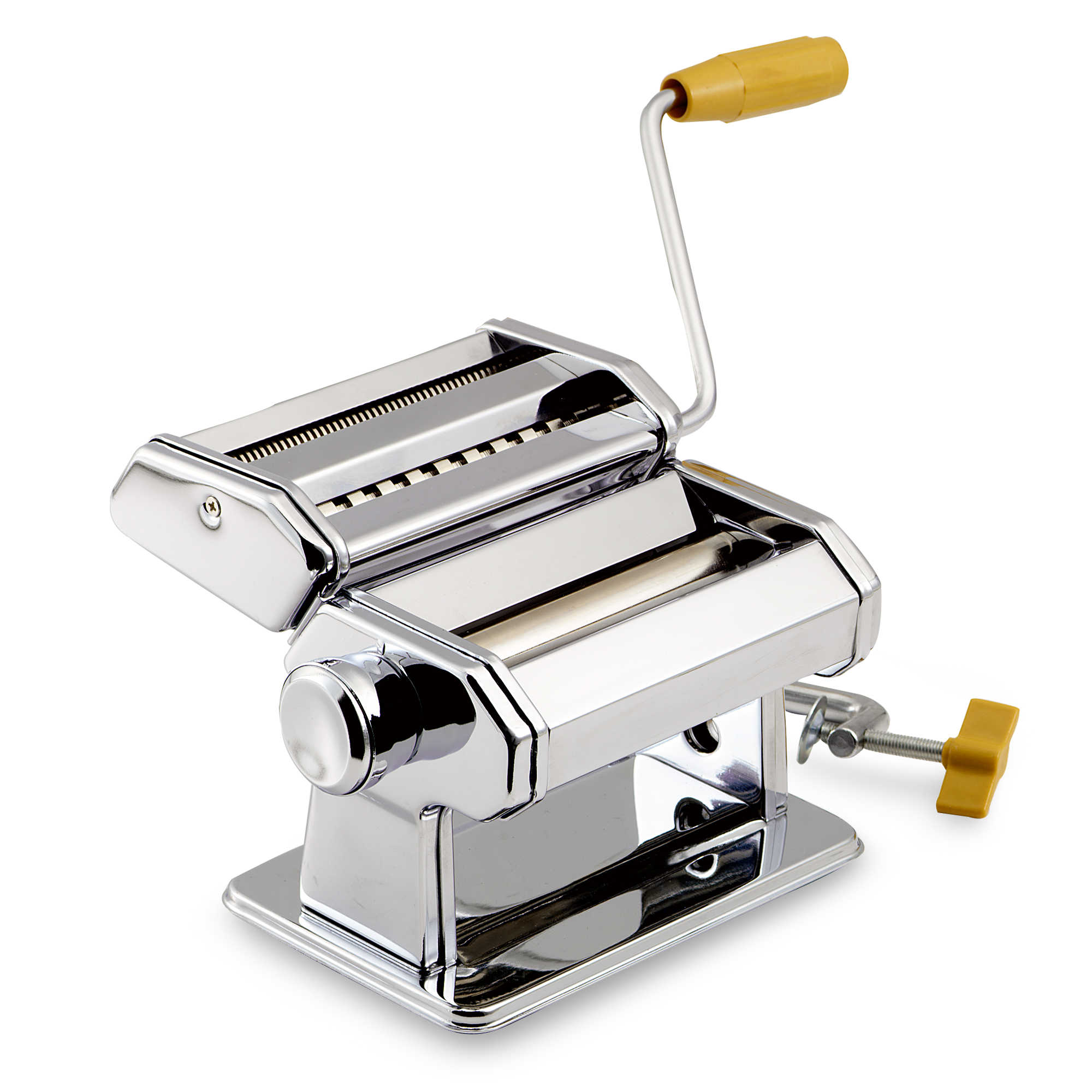
Best Manual Pasta Maker
Other attempts at more unique or innovative pasta makers have all fallen flat through the years because this design is so simple and so effective.That said, there are some important differences for you to consider before making your purchase, not least of which is whether to go with a manually operated pasta maker or an electric one.Part of the decision between them is practical: do you want to do that little bit of extra work to attain your perfect pasta?Manually operated pasta makers require you to crank a large handle to turn the rollers that feed your dough through the maker. You don't need to be particularly musclebound to perform the operation, but you might start to feel it in your shoulder if you're at the task long enough.
Electric pasta makers on the other hand have small, powerful motors built into them that operate the rollers, feeding the dough through automatically.Part of the decision between them is practical: do you want to do that little bit of extra work to attain your perfect pasta? Another part of it, though, is aesthetic: do you want to adhere more closely to the traditional mechanical method of making pasta, or are you comfortable handing that task over to the machine entirely?Personally, the workload on a manual maker is so light, and the reward feels so much greater, that I opt to do it by hand. If you have issues with arthritis or, or if you need to make larger quantities of pasta in a sitting, the electric models are the way to go. But you're going to spend some time making this dough from scratch, pouring a good deal of your heart and soul into the mix as you go, so I think it's best to stay as directly involved with the process as possible until the very end. East To WestBits of historical evidence, loose references, legends, and flat out lies season the origins of pasta like so many bits of Parmesan cheese.
References to a food known as lagana in the first few Common Era centuries imply that the food was a kind of precursor to lasagna, as it consisted of flat sheets of fried dough which, in some cases, would be layered and stuffed with meat.Bits of historical evidence, loose references, legends, and flat out lies season the origins of pasta like so many bits of Parmesan cheese.The thin strips of such dough we associate with pasta and the pasta makers on this list were likely an from roughly the fifth century. Some records imply that the Emirate of Sicily first encountered pasta at the hands of Arabs in the ninth century.Then, there's the legend of, who supposedly traveled to China in the thirteenth and fourteenth centuries and brought the concept of the noodle to the dough used in lagana and other Italian dishes of the time. There isn't a lot of evidence to back up this particular legend, unfortunately.The pasta maker itself has equally cloudy origins, as the noodles were primarily made by hand for so many years. There is one reference in Greek mythology to a device Hephaestus used to make strings of dough, but mechanical pasta making didn't have a place on the scene until some time in the 1700s.Late in that century, Thomas Jefferson brought back a pasta maker from France and eventually created a few of his own.
In the 1800s, emigration to the United States from Italy began a steady rise that would bring all the delicious cuisine of the peninsular nation to American shores. Last updated on September 20, 2018 byBuilding PCs, remodeling, and cooking since he was young, quasi-renowned trumpeter Christopher Thomas traveled the USA performing at and organizing shows from an early age. His work experiences led him to open a catering company, eventually becoming a sous chef in several fine LA restaurants. He enjoys all sorts of barely necessary gadgets, specialty computing, cutting-edge video games, and modern social policy. He has given talks on debunking pseudoscience, the Dunning-Kruger effect, culinary technique, and traveling. After two decades of product and market research, Chris has a keen sense of what people want to know and how to explain it clearly. He delights in parsing complex subjects for anyone who will listen - because teaching is the best way to ensure that you understand things yourself.
Thanks for reading the fine print. About the Wiki: We don't accept sponsorships,free goods, samples, promotional products, or other benefits from any of the product brands featured on this page, exceptin cases where those brands are manufactured by the retailer to which we are linking.For more information on our rankings, please read about us, linked below. The Wiki is a participant in associate programsfrom Amazon, Walmart, Ebay, Target, and others, and may earn advertising feeswhen you use our links to these websites. These fees will not increase your purchase price,which will be the same as any direct visitor to the merchant’s website.If you believe that your product should be includedin this review, you may contact us, but we cannot guarantee a response, even if you send us flowers.